
 Facebook
 Youtube

October 5, 2026
Ahead of papal visit, archbishop warns of a ‘wounded Argentina’ at Our Lady of Luján shrine
WORLD
By David Agren, OSV News
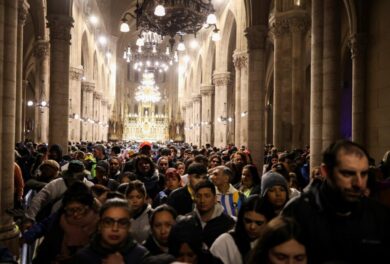
Pilgrims pray inside the Basilica of Lujan in Argentina on the outskirts of Buenos Aires, Oct. 4 2026, as they take part in the annual procession in honor of Our Lady of Luján before Pope Leo XIV’s trip to the country. In November, Pope Leo will travel to Argentina, Peru, and Uruguay. It will be the first papal visit to Latin America of Pope Leo’s pontificate and his longest international journey to date. (OSV News photo/Antonio Becerra Pegoraro, Reuters)
BUENOS AIRES, Argentina (OSV News) — Archbishop Jorge García Cuerva of Buenos Aires pleaded for unity, describing the country as wounded and deeply divided ahead of a visit to Argentina by Pope Leo XIV.
“Our homeland is needing many embraces,” he said in an Oct. 4 homily while celebrating Mass outside the Basilica of Our Lady of Luján, home to the national patroness, at the conclusion of an annual archdiocesan pilgrimage.
The country required “embraces of forgiveness in the face of so much disparagement and insults; embraces of solidarity in the face of so much indifference; embraces of reconciliation in the face of so much loss; deep embraces — not merely formal ones — embraces from the soul,” he told the pilgrims, many of whom had walked roughly 37 miles from the St. Cajetan shrine in Buenos Aires to Luján.
“Just as we tend to our blisters, Mother, we wish to heal the bonds between us. The wounds caused by disparagement, intolerance, and physical and verbal violence are already festering, and, it seems, the heart of the Argentine people is becoming infected,” Buenos Aires’ prelate underlines.
The youth pilgrimage has drawn participants from across Argentina since 1974, drawing an estimated 2.7 million people in 2026, according to the Buenos Aires state government. Archbishop García Cuerva called the act of pilgrimage, “An expression of life,” which offered lessons in tough times.
— Pope Leo arriving in Argentina Nov. 8 —
The 2026 pilgrimage unfolded barely a month before the visit of Pope Leo XIV, who arrives in Argentina for four days on Nov. 8 as part of his first apostolic journey to the Americas. The trip begins Nov. 6 in Uruguay and ends Nov. 17 in Peru, where Pope Leo previously served as an Augustinian missionary and bishop.
Argentine media closely covered the pilgrimage — with images appearing on news channels and social media of soaked pilgrims in plastic ponchos trudging through inclement weather to Luján, where skies cleared overnight for the early morning Mass.
Paulina Cabeza, 19, a pilgrim from the province of Entre Ríos, north of Buenos Aires, hoped reaching the shrine would be “an enormous sense of relief” as she set out for Luján.
“You find yourself facing this moment when you finally arrive. It’s an emotional experience. You tell yourself, ‘I did it,’ because you’ve spent the whole year preparing for this walk, living through so much along the way. When you finally get there, it’s like a release,” said Mariano Gauna, 44, a construction worker making his 10th pilgrimage to Luján.
Many of the pilgrims spoke of their personal reasons for participating, focusing on faith rather than politics — though they spoke of the hardships confronting Argentina, where nearly one-third of the population lives in poverty and political divisions remain rife.
— Country in ‘difficult situation,’ say pilgrims —
“The country is in a difficult situation right now,” said Martín Detrueba, 57, a metalworker who has made the pilgrimage every year since 1989. “Sometimes one government gets the blame, then another, yet things have been going badly across several administrations. You can’t hold just one responsible; it involves many governments.”
Detrueba looked forward to Pope Leo’s visit, describing it as “a joy that a pope is coming.” But he added, “Personally, it pains me that (Pope) Francis didn’t come, because with Francis … we have already walked together,” he said, explaining the late pope always participated in the pilgrimage to Luján while archbishop of Buenos Aires.
Much of the media attention from the pilgrimage centered on Archbishop García Cuerva, who told Argentine media on Oct. 2 that Pope Leo would find “a wounded Argentina, a divided Argentina,” a country with a famous “rift,” on his visit. The rift — known as “la grieta” — splits Argentina politically between Peronist and anti-Peronist factions, according to analysts.
“An Argentina in crisis awaits the pope, with a great number of very poor brothers and sisters,” Archbishop García Cuerva said. “An Argentina where disparagement and intolerance are the order of the day,” and a country where “a very large percentage of our fellow citizens” are “struggling,” the archbishops said, underlining fellow citizens “have been living in deep poverty for many years.”
Prominent political commentator Carlos Pagani predicted a potentially tricky visit for Pope Leo, whose predecessor, Pope Francis, never returned to his homeland after being elected in 2013. Analysts posit Pope Francis, who was born Jorge Mario Bergoglio, preferred to avoid the polarization of Argentina, where some came to see him as a political actor due to his teachings on poverty and preference for the poor.
“The man arriving will be somewhat uncomfortable for the government,” Pagni told La Voz del Interior. “He is proving to have greater political aptitude than initially assumed — back when people thought an innocuous figure was arriving to heal the wounds caused by the politicization of Bergoglio.”
— Pope Leo’s visit to spotlight county’s challenges, analysts say —
One issue Pagni cited was the pope’s planned visit to the Pequeño Cottolengo Don Orione, which serves people with developmental disabilities. Argentina’s President Javier Milei has cut funding for disabilities as part of his austerity measures — along with failing to index senior’s pensions for inflation and slashing other social services and government programs.
“They’ve taken away so many things from us, many benefits, many therapies,” Clarisa Islas, whose two children attend the Pequeño Cottolengo Don Orione, told OSV News. “We are juggling to ensure our children don’t lose their rights or the visibility they have achieved,” the mother said while preparing for the pilgrimage and wearing a shirt with a photo of her two children — Juli, 10, and Juan, 8 — who were both diagnosed with cerebral palsy and autism.
“I’m going to give thanks” on the pilgrimage “because when they were born, I was told nothing could be done for them. But today they walk and talk, and I have come to give thanks because they are able to speak.”
The Argentine bishops’ conference said Oct. 5 that it would meet with health ministry officials to discuss disability issues.
Father Lucas Arguimbau, rector of the St. Cajetan shrine, where Argentines come to pray for work and give thanks for blessings received, said demand for social services continues climbing — with the shrine’s soup kitchen serving 800 people three times weekly.
“If they’re looking for work, it’s difficult,” Father Arguimbau said. “And there are many people with work issues and the fear of losing their jobs, too.”
Milei disparaged Pope Francis as a “communist” while running for office, but later attended the pope’s funeral and called him “the most important Argentine in history.”
Milei’s approval rating has sunk in recent months as the economy stagnated in 2026. The president points to achievements, however, such as triple digit inflation being tamed and the poverty falling from more than 50% of the population to roughly 32.3% in the most recent measurement. He has enthusiastically promoted Pope Leo’s visit to Argentina.