

 Facebook
 Youtube

May 2, 2026
Appeals court temporarily blocks policy permitting distribution of abortion pill by mail
NATIONAL
By Kate Scanlon, OSV News
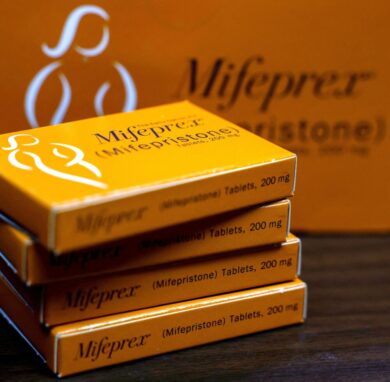
Boxes of mifepristone under the label Mifeprex are seen April 9, 2024, at Alamo Women’s Clinic in Carbondale, Ill. An appeals court on May 1, 2026, temporarily blocked a federal policy permitting mifepristone, sometimes called the abortion pill, to be dispensed through the mail. (OSV News photo/Evelyn Hockstein, via Reuters)
WASHINGTON (OSV News) — An appeals court on May 1 temporarily blocked a federal policy permitting mifepristone, sometimes called the abortion pill, to be dispensed through the mail.
The U.S. Court of Appeals for the Fifth Circuit granted Louisiana’s request to temporarily pause the Food and Drug Administration’s policy permitting mifepristone — a drug commonly, but not exclusively, used for first trimester abortion — to be mailed into the state despite its own laws restricting abortion.
Attorney General Liz Murrill, a Republican, said in a May 1 statement, “The Biden abortion cartel facilitated the deaths of thousands of Louisiana babies (and millions in other states) through illegal mail-order abortion pills.”
“Today, that nightmare is over, thanks to the hard work of my office and our friends at Alliance Defending Freedom. I look forward to continuing to defend women and babies as this case continues,” Murrill said.
Previously, Murrill, alongside Rosalie Markezich, who said she was coerced into taking abortifacient drugs by her then-boyfriend, sued the FDA over a policy permitting mifepristone to be distributed by mail. The suit contends the policy enabled Markezich’s former partner to acquire the drug from a California doctor, whom Markezich says never spoke with her, and then coerced her into taking it.
But a federal judge on April 7 paused Louisiana’s lawsuit challenging the FDA’s approval of mifepristone pending its promised safety review, indicating the state could continue its challenge after that review.
U.S. District Judge David Joseph in Lafayette, Louisiana, said that the state’s challenge to a 2023 rule allowing mifepristone to be dispensed by mail should not proceed until the FDA conducts its promised safety review and indicates whether it will seek to repeal the regulation. After that ruling, Murill sought an injunction on the policy from the appeals court.
Mifepristone’s regulations previously required the drug to be dispensed in-person, but the Biden administration eased restrictions on mifepristone to permit its distribution by mail after the 2022 Dobbs v. Jackson Women’s Health Organization decision.
However, the Trump administration has thus far left that regulation in place, and has sought to block state challenges such as Louisiana’s, pointing to a promised safety review by the FDA. However, the status and timeline of the FDA’s review are unclear.
The Trump administration’s efforts to block those lawsuits have prompted frustration from pro-life advocates who support the lawsuits.
Marjorie Dannenfelser, president of Susan B. Anthony Pro-Life America, said in a May 1 statement that the ruling from the appeals court is “a huge victory for victims and survivors of Biden’s reckless mail-order abortion drug regime.”
“We are so grateful for the tenacity of Attorney General Liz Murrill, abortion drug coercion survivor Rosalie Markezich, and all our allies demanding action,” she said. “Women and children suffer and state sovereignty is violated every day the FDA allows abortion drugs to flood the mail — harms that are no mere accident, but predictable outcomes of the FDA’s unscientific removal of safeguards like in-person doctor visits.”
“Mail-order abortion drugs are the biggest factor in rising abortion rates after Dobbs and a new wave of violence toward pregnant women, fueled by easy online access to deadly drugs,” Dannenfelser said. “More and more women like Rosalie are coming forward, fighting for justice. It’s shameful that the Trump administration’s inaction has forced pro-life states to take their battle to the federal courts. The FDA does not need a year or more to complete a comprehensive study before it can take dangerous abortion drugs out of the mail – that’s just common sense.”
Proponents of mifepristone — the first of two drugs used in a chemical, sometimes called medication abortion — argue it is statistically safe for a woman to take, and attempts to restrict it are an attempt to ban abortion outright. Opponents of the drug’s use for abortion argue there are significant risks to those who take it, particularly outside of medical settings, in addition to ending the life of an unborn child early in its development.
The Reproductive Freedom Caucus, a group of lawmakers in the U.S. House of Representatives that opposes abortion restrictions, argued in a statement on X that the drug is “safe and effective for millions of people since who have ended early pregnancies and managed miscarriages, at home and in health care facilities.”
The Catholic Church teaches that all human life is sacred from conception to natural death, and as such, opposes direct abortion.
Approved by the FDA for early abortion in 2000, mifepristone — the first of two drugs used in a medication-based abortion — gained the moniker “the abortion pill.” However, the same drug combination has sometimes been used in recent years for miscarriage care, where an unborn child has already passed, a situation that Catholic teaching would hold as morally licit use.