

 Facebook
 Youtube

April 21, 2026
OP ED: A pope and a president: A study in contrasts
REGIONAL
By Fr. John F. Tuohey
In July 1963 Paul VI succeeded John XXIII as Pope of the Catholic Church. In November of that year Lyndon Johnson succeeded John Kennedy as President of the United States after his assassination in Dallas, Texas. Johnson, with the support of the leading Cardinals of the US and US Catholics at the time vigorously pursued the Vietnam War. Bombing was a major military strategy.
Paul VI equally as vigorously opposed the War and was most outspoken against the bombing. He did not shy from telling 150,000 gathered in and around St Peter’s Square the bombing was morally wrong and had to stop.
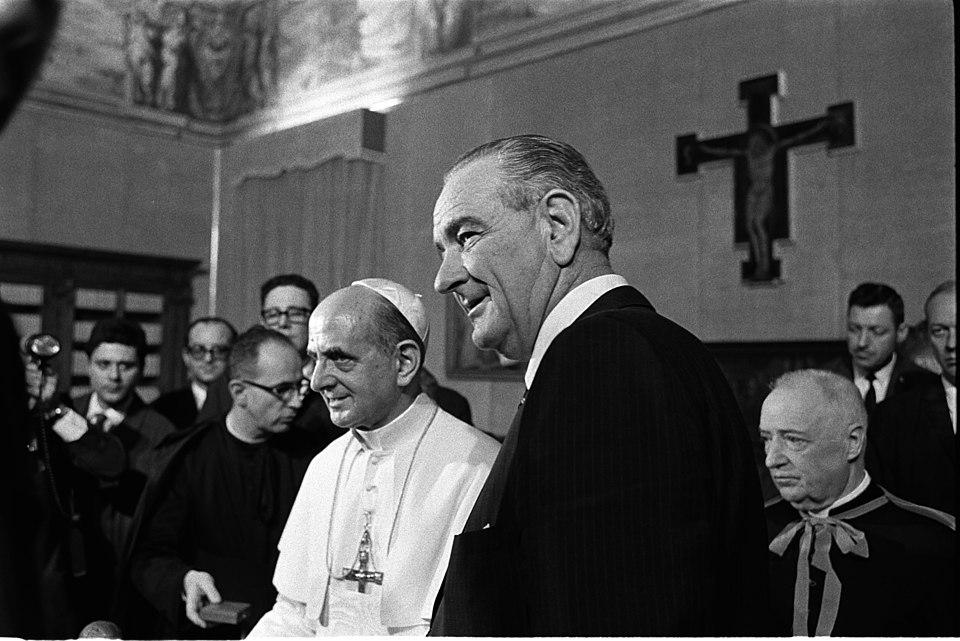
Pope Paul VI and US President Lyndon B. Johnson, Dec. 23, 1967
Even though these two leaders were opposed to each other’s position about the war they enjoyed a cordial and civil relationship. Johnson, in fact, a member of the Disciples of Christ, often attended Catholic Mass when back at his ranch in Texas, and often sought solace in the middle of the night before the Blessed Sacrament at the Dominican Priory in Washington, DC.
When Paul VI became the first Pope to speak at the UN, calling for “War never again!” the President loaned him the First Lady’s limousine with its bubble top, offering the Pope some protection from the cool, blustery October day. The two met for almost an hour at the Waldorf Astoria, with the President walking the Pope back to his limo as if he were making a state visit at the White House.
The two exchanged letters after Johnson’s election in 1964 stating their views, always civilly and respectfully even if at times talking past each other. When the President literally dropped in at the Vatican nearly unannounced to, as The New York Times put it, “Set the Pope Straight on Vietnam” on Dec. 23, 1967, it was the Pope who set the President straight, forcefully demanding the US bombing stop.
The North was by this time demanding this as a pre-condition to peace talks. The bombing stopped in March 1968. When the North failed to respond, Johnson reached out to Paul VI asking him to intervene, to invite the North to the Vatican to meet with US officials. Paul VI did, and 48 hours later the North accepted the Pope’s invitation to US negotiations, suggesting Paris on or about May 10. And so, the talks began.
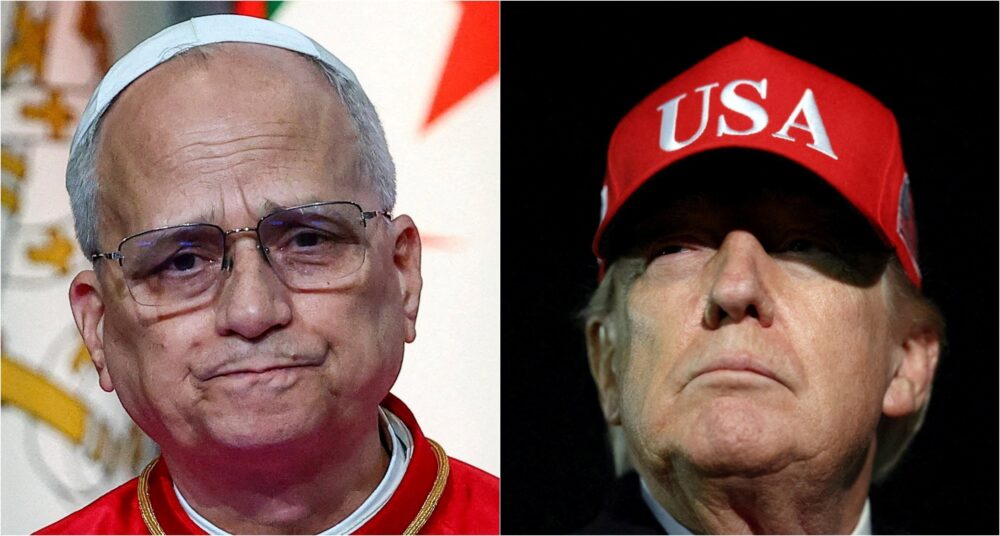
A combination picture shows Pope Leo XIV addressing Algeria’s political leaders at the cultural center of the Great Mosque of Algiers in April 13, 2026, where he criticized violations of international law by “neocolonial” world powers, in the Mohammadia of Algiers, Algeria, April 13, 2026, and U.S. President Donald Trump after disembarking Air Force One at Joint Base Andrews in Maryland April 12, 2026. (OSV News photo/Guglielmo Mangiapane/Kevin Lamarque, Reuters)
In all this, Paul VI was never mocked or called weak. No words ever emanated from the White House that would cause Paul VI to need to comment that he had nothing to fear from the President. No one ever said Johnson owed Paul VI an apology or told him to “stick to morality.” Johnson knew war was about morality. And he listened. The most critical comment made of Paul VI was Secretary of State Dean Rusk’s suggestion that he did not have a “balanced neutrality.”
There is no need for me to contrast Johnson with Donald Trump: his comments and behaviors are all too obvious. Pope Leo XIV has clearly taken a page out of the playbook of Paul VI concerning the war in Iran. Trump and the US would do well were he to take a page out of Lyndon Johnson’s playbook in his dealings with the Vicar of Christ, the “Prince of Peace.”
Editor’s Note: Fr. John F. Tuohey is a retired priest of the Diocese of Springfield. He is author of “Pope Paul VI and His Quest for Peace 1963-1978”, Volumes 1 & 2.