

 Facebook
 Youtube

August 10, 2011
Former New York Gov. Hugh Carey remembered as ‘superb public servant’
NATIONAL
By Catholic News Service
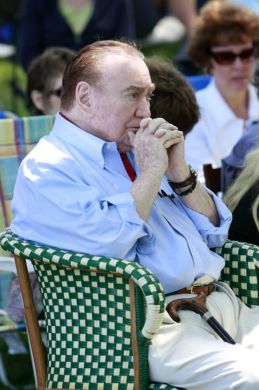
(CNS photo/Gregory A. Shemitz, Long Island Catholic)
NEW YORK (CNS) — Former New York Gov. Hugh Carey, who died Aug. 7 at age 92, was “a superb public servant whose commitment to our nation and state was extraordinary,” said Bishop Howard J. Hubbard of Albany.
Carey, a Catholic, “demonstrated great vision and courage in confronting the fiscal crisis in New York City in a bipartisan fashion, while at the same time protecting the needs of the most vulnerable in our Empire State: the poor, children, the mentally ill and the elderly,” Bishop Hubbard said.
A funeral Mass was scheduled to be celebrated for Carey Aug. 11 at St. Patrick’s Cathedral in New York.
“The governor was a role model of faith, integrity and civility in a society where such is needed today so desperately,” added the bishop, who is chairman of the New York State Catholic Conference’s Public Policy Committee. He has headed the Albany Diocese since 1977.
Carey served two terms as governor, from 1975 to 1982, and before that he served seven terms as a congressman.
During his tenure Carey led the effort that brought New York City back from the brink of bankruptcy during its 1975 fiscal crisis.
While he was governor, Carey was an opponent of the death penalty but a supporter of legal abortion. He later reversed his opinion on abortion and became pro-life. He told a March for Life crowd in Washington in 1990 that while in office he agreed with state money funding abortions and was unaware of the true nature of the issue.
“I went along with that (funding), to my eternal regret,”‘ he said. “There is no basis for spending money to encourage abortions in this country.” He said abortion foes will eventually win because “the politics of life have always triumphed over the politics of death.”
That year in an interview with The Long Island Catholic, newspaper of the Diocese of Rockville Centre, Carey said church sanctions he faced for his support for Medicaid-funded abortions helped him re-examine his position.
He said he had been told by Cardinal Terence Cooke, then archbishop of New York, that he could not receive Communion because of his marriage outside the church to a divorced woman and for his support of using Medicaid money for abortions.
The restriction, levied privately by Cardinal Cooke, was carried on by his successor, Cardinal John O’Connor, until March 1988, Carey said.
“I recognized the church’s authority,” Carey said, and accepted the penalty while continuing to attend Mass, but without receiving Communion.
Eventually the sanctions reinforced his own misgivings about his abortion stand, Carey said. Having opposed the death penalty, he said “I felt inconsistent” about backing Medicaid-funded abortions.
Among the difficulties he faced, Carey said, was the uncertainty over whether a restriction on Medicaid abortion funds would survive a court challenge.
One factor which led him to re-evaluate his public position on abortion, he told The Long Island Catholic, was that “I felt burdened by the number of abortions” that took place in the United States, which at that time was estimated to be 1.5 million each year.
Legal challenges to Roe v. Wade, the 1973 U.S. Supreme Court case that permitted legal abortion, and reservations about it voiced by former Chief Justice Warren Burger gave him further cause, Carey told The Long Island Catholic.
The sanction on Communion gave him the feeling, he added, “that you have lost something. It’s like being unable to go to your mother’s house for a holiday.”
He criticized Catholics in public office who support legal abortion as “cafeteria Catholics,” adding that Catholic officeholders cannot isolate their opposition to abortion from public life.
Not putting beliefs into practice in a pluralistic setting can be ignored “in terms of what schools you attend or whether or not supermarkets are open on Sundays,” Carey said, “but not when it is a matter of life or death.”
Cardinal Edward M. Egan, retired New York archbishop, called Carey “a marvelous political leader and a dear friend.”
“I will deeply miss his wise counsel and many kindnesses to me, during my years as archbishop of New York and afterward as well,” he said.
Carey was a native of Brooklyn and a World War II veteran. His first wife, Helen, died of cancer in 1974. In 1981, he married Evangeline Gouletas, who was divorced. That marriage ended in 1989. He is survived by 11 children.