

 Facebook
 Youtube

October 2, 2026
St. Michael’s Cathedral celebrates 160th anniversary of consecration
REGIONAL
By Stephen Kiltonic
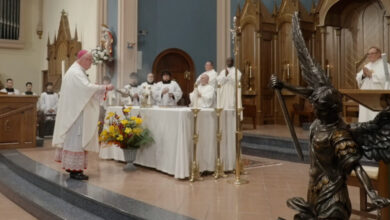
Bishop William D. Byrne celebrates Mass for the 160th anniversary of St. Michael’s Cathedral, Sept. 30. (IObserve photo/Bill Pacocha)
SPRINGFIELD – On Wednesday, Sept. 30, the parish community of St. Michael’s Cathedral celebrated the 160th anniversary of its consecration with a Solemnity Mass led by Bishop William D. Byrne, Father Gary M. Dailey, St. Michael’s rector, and four diocesan priests. St. Michael’s, then a church, was consecrated on September 30, 1866, by Bishop John Joseph Williams of Boston making it the first consecrated church in New England.
“Who doesn’t love a birthday? But, especially the birthday of the mother of our church here in western Massachusetts,” said Bishop Byrne.
“It’s significant and it’s important to call to mind the history of the Diocese of Springfield. We want to celebrate 160 years of history: the many people that have come through here; the many bishops that have taken their seat here; the many sacraments that have been issued here. This is really the cathedral church of the people. So, everyone’s welcome here,” added Father Dailey.
The first Catholic house of worship for the mainly Irish immigrants in Springfield was a former Baptist church that was purchased and reconfigured in 1947. It was named St. Benedict’s in honor of Boston’s Bishop Benedict Fenwick, a staunch supporter of the new parish. However, the parish soon outgrew the modest building.
Father Michael Gallagher, an energetic and astute young priest from Boston, arrived in 1855 with a vision to build a much larger house of worship for the burgeoning Catholic population. Through some fiscal wisdom and shrewd land acquisitions, Father Gallagher purchased property on State Street as well as additional properties which he later sold to pay for the construction of the new church.
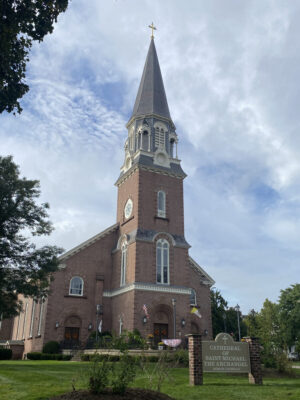
(IObserve photo/Stephen Kiltonic)
“It was booming at that time. State Street was a very active street because of the armory right next door. So, there was a lot of hustle and bustle around this area. Having St. Michael’s church on this street was very significant,” said Father Dailey.
Father Gallagher also managed to get the renowned New York architect Patrick C. Kieley, to design the church at a cost of $75,000. The cornerstone was laid on the Feast of St. Michael the Archangel, September 29, 1860 just five months after the Civil War began. A large percentage of Springfield’s soldiers who fought for the Union had Irish or French-Canadian names. Throughout the war, Father Gallagher provided spiritual support and solace for the troops during departures and returns from the battlefields.
Construction went quickly and St. Michael’s celebrated its first Mass on Christmas Day, 1861 in the “presence of the largest congregation of Catholics ever assembled together in Springfield,” according to church historian E.A. Hall. When the church was consecrated five-years later, it was debt-free thanks to Father Gallagher, the first pastor.
“Father Gallagher was a brilliant man with the foresight to say, ok, we need to create a Catholic center here in the middle of Springfield and that’s what he did,” said Bishop Byrne. Later, the Sisters of St. Joseph motherhouse as well as Cathedral High School and grammar school were constructed on property adjacent to St. Michael’s. “He was really a remarkably holy man who much have been really listening to the holy spirit,” added Bishop Byrne.
Father Gallagher, buried at the entry of St. Michael’s, died in 1869, just before church became the cathedral seat of a newly formed Springfield Diocese in 1870.
Some of the significant features of the cathedral that make it unlike any other churches in the diocese include the cathedra, or the seat of the bishop. “That symbolizes the teaching authority of the bishop. It’s solely his chair. No one else sits in that chair without his permission,” added Father Dailey who noted the bishop’s coat of arms above the chair.
In addition, all the holy oils used by parishes throughout the year are stored at the cathedral. The stained glass windows depict the various duties of the bishop and include the health ministries of the Sisters of Providence as well as Elms College, founded by the Sisters of St. Joseph. The 12 sconces on the walls of the consecrated cathedral represent the 12 apostles which are lit during important diocesan events like the anniversary.
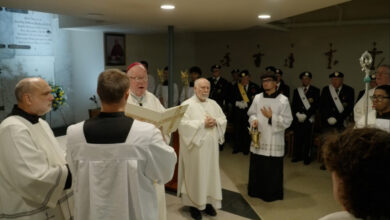
Bishop William D. Byrne blessed a newly engraved door on the tomb of Bishop Timothy A. McDonnell who was laid to rest in the St. Augustine Crypt Chapel March 13, 2026. (IObserve photo/Bill Pacocha)
In St. Michael’s bell tower rests the Hooper Bell, which was crafted by Paul Revere’s son-in-law, and still rings today. Today, Father Dailey uses an engraved chalice of Father Gallagher’s during weekend Masses. It was discovered in a cathedral safe which had to be cracked open after being closed for many years. The Casavant organ, which was the largest organ in Massachusetts when it was installed, will celebrate 100 years in 2028.
After the Mass, Bishop Byrne led a procession outside the cathedral and down into the St. Augustine Crypt Chapel where he blessed the newly engraved door to the tomb of Bishop Timothy McDonnell, who was laid to rest on March 13, 2026.
Bishop McDonnell is the fourth bishop to be buried in the crypt, the last being Bishop Thomas O’Leary in 1949. “When he retired here, he didn’t go back to New York. This had become his home. He chose to make this his eternal home,” explained Bishop Byrne.
“He wanted that top right corner because, he said, he wanted the corner office. He had such a great sense of humor and it just showed his love for the diocese and his desire to be part of this community til’ the end of time,” added Bishop Byrne who led the priests and attendees in singing a closing Salve Regina.