

 Facebook
 Youtube

May 6, 2026
Lebanese priests overjoyed by a surprise video call from Pope Leo
WORLD
By Dale Gavlak, OSV News
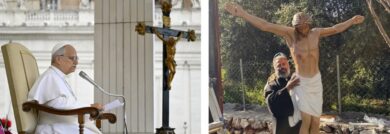
A combination photo shows Pope Leo XIV delivering remarks during his weekly general audience in St. Peter’s Square at the Vatican May 6, 2026, and Father Fadi Felefli, pastor of St. George Parish in Debel, Lebanon, holding a new statue of the crucified Jesus April 22, 2026. It replaced one that had been damaged earlier by an Israel Defense Forces soldier. (OSV News photo/Vatican Media, courtesy Debel alert)
AMMAN, Jordan (OSV News) — Lebanese Catholic priests serving in the south of the country near the border with Israel said they were overjoyed to discover that a call with Lebanon’s papal nuncio included another special guest on the online visit, Pope Leo XIV.
“First, it was a surprise, then it was a great joy,” Lebanese Maronite Catholic parish priest in Rmeich, Father Toni Elias, told OSV News by phone of the encounter with Pope Leo on May 6.
“This opportunity took place due to the grace of the papal nuncio (Archbishop) Paolo Borgia, who initiated the online contact with us,” said Father Elias, who was one of 13 Catholic priests engaged in the call with Pope Leo, who spoke in French with them.
Archbishop Borgia met with Pope Leo during a private audience May 6 at the Vatican and called a group of priests from the Apostolic Palace.
The 13 priests who received a video call serve in Lebanon’s southern villages and towns, including Rmeich, Ain Ebel, Debel and Marjayoun.
“The pope greatly encouraged us,” the priest said. “It was very wonderful because we felt the spirit of hope and joy descend upon us,” said Father Elias.
“This encounter with the pope was a reminder to us that we serve a Church that is unique in all of the world,” he said.
“The Holy Father wished to give us good courage in the face of difficulties that our Christian community has faced in these past days. He prayed over us and spoke the benediction,” said Father Elias.
Earlier, Father Elias told OSV News that he and the faithful in Rmeich “100% sense Jesus’ presence and support” as they daily pray together.
“Otherwise, how could we manage to remain here,” he said of Rmeich, the last village in Lebanon’s south on the border with Israel. Rmeich has been caught in the crossfire between Israel and Lebanon’s Iran-backed Hezbollah militia, a deadly side conflict of the Iran war.
“This opportunity to talk with the pope came quite unexpectedly,” Father Fadi Felefli, Maronite Catholic parish priest at St. George Church in the village of Debel, told OSV News by phone.
“The Holy Father greeted us, blessed us and prayed with us. He told us that we and our people are always in his prayers. He told us that it was a big ministry that we are undertaking at this moment,” said Father Felefli, another priest who participated in the call.
“We were so happy to receive this blessing and sense of peace the Holy Father brought to us through his words and care,” said Father Felefli.
“It was incredible to experience this great communication. And to know that he is concerned for our Church, the Christians and believers in this land. We are so grateful,” he added.
Lebanese Christians in Debel celebrated the gift of a new statue of Jesus after an act of desecration by two Israeli soldiers drew global outrage.
Israel’s military removed two soldiers from combat duty and placed them in military detention for 30 days after they destroyed the village’s crucifix.
The social media picture of an Israeli soldier taking the blunt side of an axe to a fallen sculpture of Jesus on the cross drew worldwide condemnation April 20 and apologies from Israeli Prime Minister Benjamin Netanyahu and other officials.
A contingent of soldiers from Italy serving with the United Nations Interim Force in Lebanon, known as UNIFIL, donated a new replacement crucifix to the Debel Christian community.
A few days before the May 6 papal call, the Israeli military demolished a Catholic convent and school in the border village of Yaroun, according to L’Osservator Romano.
The Council of Melkite Greek Catholic Bishops in Lebanon urged the Lebanese government and the United Nations to protect the property of civilians and religious institutions in south Lebanon. They drew attention to Yaroun, where officials said Israeli troops destroyed a Melkite convent earlier this month, among other demolitions.
The bishops called the destruction of buildings, after residents of the area had evacuated, a “deep wound in the national and human conscience,” according to The Associated Press.
The French Catholic charity L’Oeuvre d’Orient condemned what it called the “deliberate act of destruction of a place of worship and the systematic destruction of homes in southern Lebanon aimed at preventing the return of civilian populations.”
Despite a ceasefire on April 17, Israel has expanded its control of border areas in south Lebanon in its latest war against Hezbollah, which began March 2, by forcing many inhabitants to flee and its military raining widespread destruction on a vast region that includes Christians and Shiite Muslims.