

 Facebook
 Youtube

April 25, 2026
Disability ministry in the Church is making strides, but needs more widespread adoption in parishes
NATIONAL
By Simone Orendain, OSV News
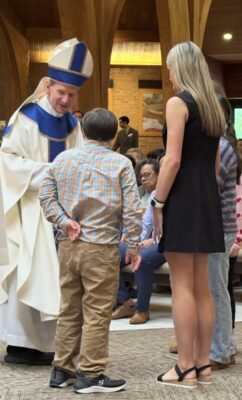
Bishop Michael F. Burbidge of Arlington, Va., greets Luke Fernandez, one of the gift bearers at the offertory, during the SPRED Mass at St. Timothy Church in Chantilly April 19, 2026. The SPRED ministry in the Diocese of Arlington fills the gap especially for children who go to public school where special needs are addressed but not religious education, Nancy Emanuel, the coordinator, told OSV News. (OSV News photo/Kevin Thomas for The Catholic Herald)
CHICAGO (OSV News) — On Easter in Chicago’s St. James Catholic Church, a congregation made up mostly of people with disabilities and their families attended the Chicago archdiocesan Special Religious Development ministry’s Mass like any other time of year.
There was one reading and the week’s Gospel passage, acted out by servers, with a sung psalm that children and catechists formed a ring of linked hands and swayed to. Mass, baptisms and other sacraments of initiation for SPRED, as the ministry is best known, were scheduled for future dates, not during an Easter Vigil.
“I’m just very happy that this organization exists for my boys because I feel like they maybe wouldn’t be able to make their sacraments until they were so much older,” said Lydia Arroyo the mother of an 11-year old with autism and attention-deficit/hyperactivity disorder, or ADHD, and a 9-year old who she said was showing some signs of those conditions. Both received confirmation and first Communion at a SPRED Mass in May last year.
Arroyo, 48, told OSV News that her eldest, Constantino, struggled to pay attention during the children’s catechism program at her church. And since registering her sons in SPRED in 2023, she said, Constantino is a bit more attentive and can follow the twice-monthly liturgy and catechism lessons in shortened segments from a catechist who would ideally be partnered with him long-term.
The SPRED ministry in the Diocese of Arlington, Virginia, fills the gap especially for children who go to public school where special needs are addressed but not religious education, Nancy Emanuel, the coordinator, told OSV News.
She said Catholic schools in the diocese have special education services for those with mild cognitive and physical disabilities. The people served by the SPRED program, however, typically have more significant disabilities, and their needs cannot be met in typical educational settings. SPRED provides religious instruction, sacrament preparation, and the connection to the parish community that promotes inclusivity in typical parish ministries and activities.
“We’ve had people with feeding tubes, people in wheelchairs, people who may not have the cognitive ability to fully absorb your typical religious instruction. But the SPRED program … is more of a relational design. Children understand that Jesus loves them just the way they are … even if they can’t read or write, even if they can’t walk. They are just the way they’re supposed to be,” she said.
Bishop Michael F. Burbidge of Arlington expressed gratitude for the program at the April 19 SPRED Mass in his diocese. He offered encouragement to the children attending.
“To all of you, my young friends, I thank you for the inspiration you are for us,” he said. “You are a special gift to me and to our entire diocese. We love you and will always support you!”
Bishop Burbidge added, “To your parents, family, catechists, teachers, and spiritual friends: We thank you for all that you do to share our faith with our young people; but most especially, for helping them to remember that God loves them without exception and longs for them to draw closer to him in prayer, in the sacraments, and in learning and living their faith.”
SPRED originated in the late 1960s in Chicago and follows the model of pairing a catechist with a person who has a disability (ages 6 and beyond), within a group setting.
While SPRED is specifically for people with disabilities, it is in just 19 dioceses in the United States and in seven countries around the world.
Yet, according to the U.S. Census Community Survey of 2022, 44.1 million Americans — or 13% of the population — registered that they had disabilities.
Charleen Katra, head of the Washington-based National Catholic Partnership on Disability, said among U.S. Catholics the percentage of those with disabilities is like the national figures.
NCPD was set up under the directive of the U.S. Conference of Catholic Bishops 45 years ago. Katra said the conference is in the process of updating its 1978 pastoral guidance on disability ministry.
NCPD sent out a survey in 2024 on disability awareness and practices to 5,000 random parishes across the nation and received 351 valid responses.
“It’s pretty low, which, honestly, tells you something in and of itself, doesn’t it? About interest in the subject and importance of the subject,” said Elizabeth Potts, researcher and associate director of diocesan relations at NCPD. “But what was unique to any of the prior surveys and work that NCPD has done in this area: There were 17 follow-up interviews. And those provided some additional information and insight.”
The survey conducted by the Center for Applied Research in the Apostolate, located at Georgetown University in Washington, found more than half of parishes surveyed have more than 10 people with disabilities. The most common disability reported was chronic illness at 75%, and the least reported was mental health at 51%. The survey also tracked chronic pain, addictions and physical mobility. Parish workers estimated about 20% of disabled parishioners had one or two disabilities and 48% were over 65 years old.
Two-fifths to half of all the respondents said they made disability accommodations for Mass, sacraments of reconciliation and the Eucharist, and children’s catechism. Almost every parish that responded said they had accessible parking near the church and accessible entrances to the church building, but only three quarters had accessible restrooms. Braille lectionaries, missals and curricula, American Sign Language Masses and other services were in single percentage points.
The common thread among many interviewed, Potts told OSV News, was that time is the biggest obstacle to raising awareness of disability and disability practices at the parish level.
Both Potts and Katra said sometimes parishioners take the initiative to request accommodations for their needs, but parishes should also anticipate that people with special needs will and do come to their churches. They said accommodating them does not always mean extensive or expansive projects.
“Attitudinal barriers don’t cost a penny,” Katra said. “Start there because … they’re harder to remove. What expedites that often is getting people with disabilities involved in the full life of your church. Start a disability ministry.”
Also, she said, “people with disabilities call us to slow down … being pastoral and hospitable to people, realizing how much they have on their platter. They’re a family who has a child with a disability. (We should) respect that they chose life.”
Katra added, “Catholics with disabilities are no different than Catholics without disabilities.”
The Kansas City-based Fire Foundation, known as FIRE, helps fund inclusivity programs in Catholic schools so that sibling sets can all attend the same schools. Children with disabilities are fully integrated into classrooms with peers of their age group.
Lynn Hire, FIRE’s immediate past executive director, said tailor-made learning is at the core of Catholic school inclusivity.
“Every student with a disability has a student education plan that outlines the modifications and the accommodations that they are going to receive,” Hire told OSV News.
The foundation provides supplemental funding to Catholic schools to train teachers, she said.
Molly Fisher, executive director of FIRE, said she has seen children with disabilities develop a “real and tangible” sense of belonging.
“It’s a beautiful thing, and as a mom of a child with disabilities, it can be very, very isolating. We all need love,” she told OSV News. “And for us as the typical Catholic community, it’s our duty (to love).”
Fisher explained this is what Jesus himself would do and is calling the Church to do.
“He would want everyone learning together, praying together, not separating someone out because they’re different,” she said. “He’s the ultimate teacher of that message.”