

 Facebook
 Youtube

March 14, 2026
St. Patrick’s ‘Confessio’ shows the human behind the halo, say experts
NATIONAL
By Gina Christian, OSV News
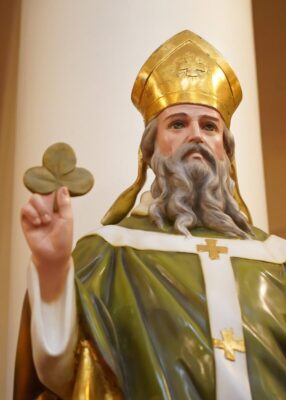
A file photo shows a statue of St. Patrick is seen at the Church of St. Michael in New York City. The feast of St. Patrick, patron of Ireland, is March 17. (OSV News photo/Gregory A. Shemitz)
(OSV News) — From Dublin to Dubuque, and Montserrat to Melbourne, the feast of St. Patrick is celebrated by millions around the world — and for as many reasons as there are revelers, from faith to cultural heritage to fun.
But the fifth-century bishop at the heart of the merriment, who became an adopted son and apostle of Ireland, is far more relatable than many realize, as the saint’s own retelling of his life shows, one scholar told OSV News.
“There are the legends of Patrick, about the snakes and the fires and the shamrocks and all of that, which are great. And then there’s the real story of Patrick, which is so much more human,” said Philip Freeman, humanities professor at Seaver College and author of “St. Patrick of Ireland: A Biography.”
Freeman, a specialist in Celtic studies and classics, pointed to the “Confessio,” in which St. Patrick recounts his remarkable journey from indifferent Christian youth to (as he would later be known) apostle of Ireland.
Born in Britain to a Romanized family, Patrick was captured at age 16 by Irish raiders and spent six years as a slave. During that time, he developed a profound prayer life, and following his escape and reunion with his family, he eventually returned to Ireland to evangelize its people.
The Latin text of the “Confessio” — found in eight manuscripts from the 9th to the 17th century, including the Book of Armagh, which dates to about 807 — was written by St. Patrick “as an old man,” Freeman said.
The “Confessio” was being quoted and paraphrased even earlier, around the year 690, said Lisa Bitel, professor of religion and history at the University of Southern California and a specialist in medieval Britain and Ireland.
In the opening line of the “Confessio,” Patrick describes himself as “a sinner, a simple country person” (“peccator rusticissimus”) and “the least of all believers” (“minimus omnium fidelium”).
He adds, “I am looked down upon by many” (“contemptibilissimus apud plurimos”), and later — referencing his slavery — describes himself as a refugee (“profuga”).
However, those “claims to humility may or may not be valid,” cautioned Bitel.
Patrick was writing as a “regional intellectual,” one who produced what is actually “quite a sophisticated document” that is “very intricately spotted with references to Scripture,” she said.
In particular, “he’s channeling St. Paul in a big way,” said Bitel, referencing the work of Harvard Irish studies scholar Joseph Falaky Nagy.
Still, said Freeman, unlike St. Augustine’s lengthier “Confessions,” which is a “polished literary story,” St. Patrick’s story is “much more informal, much more revealing.”
“He just opens himself up, unlike anybody else I know of from the whole classical world, and talks about his failures, talks about his successes, talks about his faith in God — but also about his doubts in God,” said Freeman. “And he says, ‘You know, it’s been really hard, but I have kept going.'”
The future saint “suffered very much from anxiety, from depression, from self-doubt,” Freeman noted.
That angst renders the “Confessio” a “wonderful, very human prayer,” he said.
As a youth, Patrick wasn’t exactly known for his devotion to the faith, Freeman said.
Although raised in the Church — with his father, Calpornius, a deacon and (amid an often married presbyterate at the time) his grandfather, Potitus, a priest — Patrick admits he “did not know the true God.”
Enslaved in Ireland around the year 430, he “rediscovered his faith,” said Freeman.
With Ireland as “just about the only part of Europe” unconquered by the Roman Empire, that slavery, which saw Patrick tending sheep in the field, was a life sentence, said Freeman, since under Roman law, slaves had the possibility of eventually buying their freedom.
Not so in Patrick’s Ireland, which was “made up of at least a hundred independent, very fiercely antagonistic tribes who were always fighting each other,” amid “polytheistic society” that was “like Rome or Greece before Christianity,” Freeman said.
St. Patrick recollects in the text that visions and voices guided his escape from slavery and his call to return and “walk again among” the people of Ireland, along with locutions affirming God’s closeness in prayer.
Still, on balance, “there’s nothing supernatural” about the “Confessio,” Freeman observed.
“He doesn’t work miracles in it,” said Freeman. “It’s just a man who is deeply devoted to the Gospel, who works very, very hard to spread it with mixed success for many years.”
As part of his evangelization efforts in Ireland, Patrick drew on his proficiency in Latin, Common Brythonic (the Celtic language spoken in Britain at the time) and Irish — and his experience of the culture, said Freeman.
“And that’s what made Patrick so effective,” said Freeman. “He knew the culture intimately. He’d been there; he’d lived there. There were other missionaries to Ireland, even before Patrick, in the south, but it was very much a foreign land to them.”
Bitel said that “Christianity was seeping into” Ireland prior to Patrick, with slaves, returning mercenaries and travelers, along with earlier missionaries, bringing the island’s residents into contact with the faith.
But, she said, Patrick was perhaps “the first to go way out to the wilds of Mayo” in Ireland, and “places these others hadn’t on the near coast” of the island.
His familiarity with Ireland, and his reach into those areas, may have sparked some jealousy among the bishops of Britain, who had ordained Patrick as a bishop and had sent him to Ireland in the first place, Freeman said.
In the “Confessio,” Patrick describes being “put to the test” by his superiors, who brought up an unspecified sin from his youth that he had confessed some 30 years earlier, prior to becoming a deacon.
Freeman and Bitel note that the nature of the transgression isn’t specified.
“It’s really hard to understand exactly what the charges were,” said Freeman, citing possible claims of “financial mismanagement or just not being subordinate enough.”
But Bitel, who also listed idolatry or sexual indiscretion as possibilities, stressed that “200 years of arguing among Celtic scholars” hasn’t yielded an answer on that point.
In the end, Patrick held fast to his mission, and writing in his “Confessio” as “a very wise preacher” who is “leading his audience,” the future saint seeks to show the reader “the depths and the real passion of his mission,” said Bitel.
“I would say that he was very much a devoted, orthodox, Catholic Christian who struggled mightily to fulfill his mission to preach the Gospel in Ireland,” said Freeman. “He was a man full of failures, full of doubts, but ultimately a man of great faith.”