

 Facebook
 Youtube

May 21, 2023
Training session held on end of life medical directives
REGIONAL
Story and photos by Carolee McGrath
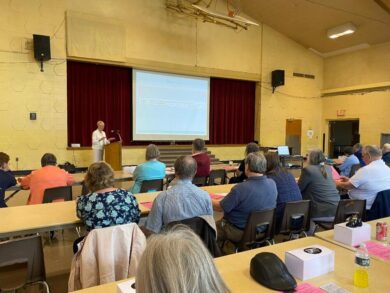
Patricia Stewart, executive director of Massachusetts Citizens for Life, presents information on the MOLST forms for end of life care directives at Our Lady of the Blessed Sacrament Parish.
WESTFIELD – A few dozen people gathered at Our Lady of the Blessed Sacrament Parish in Westfield, Wednesday, May 17, for a training session regarding end of life medical directives. The workshop was sponsored by Massachusetts Citizens for Life. The discussion focused on Massachusetts Medical Orders for Life Sustaining Treatment (MOLST).
“I am here to educate these consumers of healthcare about concerns and dangers in the medical order for life sustaining treatment knows as the MOLST form,” said Patricia Stewart, the executive director of Massachusetts Citizens for Life.
“This form was adopted by the Department of Public Health. It has established a new standard of medical practice in Massachusetts and the form itself is dangerous because it contains a lot of confusing information. It is easily misunderstood and can lead to very undesirable outcomes,” said Stewart, who is also an attorney.
Stewart said the bright pink form asks a series of questions regarding what kind of care a person would want if in certain situations. For example, would a patient want to be resuscitated if in cardiac arrest; would a patient want help breathing if in respiratory distress; or would a patient want artificial nutrition or hydration. According to the Massachusetts Department of Health website, physicians can present these forms to a patient of any age with a serious advanced illness.
“Basically it asks people to decide whether they want to have life sustaining treatment if they have an emergency, do they want to be saved or not,” Stewart said. She said these differ from a healthcare proxy because it goes into effect immediately. A MOLST form is for life-sustaining treatment. A healthcare proxy or advance directives go into effect when a person is no longer able to make a decision due to a coma, dementia or unconsciousness.
“Physicians are able to bill the federal government for every Medicare and Medicaid patient with whom they have this conversation, so there is a financial incentive for doctors to have these conversations,” Stewart said.
Catholic teaching does not require patients to undergo all medical treatments if they cause undue burden. The Catechism of the Catholic Church states: “Discontinuing medical procedures that are burdensome, dangerous, extraordinary, or disproportionate to the expected outcome can be legitimate; it is the refusal of overzealous treatment. Here one does not will to cause death…” However, the United States Conference of Catholic Bishops (USCCB) also has raised concerns over the MOLST forms that are in place in many states. The USCCB pro-life committee released a document explaining that similar forms are concerning because “it may be applied to patients who are not in a terminal situation and who might only need antibiotics, nutrition and hydration, or other proportionate care.”
Stewart said once signed, the MOLST form becomes the physician’s order to other medical staff.
“EMTs are required to follow what’s on the form,” Stewart said. “I’ve talked to EMTs who say this form is impeding their ability to do their job because people don’t know what they are signing.”
Stewart said she hoped the training would help people understand their options and their rights.
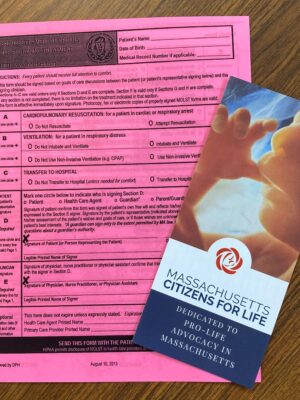
“The issue is important to me, one as a pro-lifer, two as having worked with the elderly in geriatric settings, and three because I personally experienced a problem with these MOLST forms,” said Peggy Bradford, a member of the Diocese of Springfield’s Pro-Life Commission. She served as health care proxy for a friend who recently died after a short battle with cancer. Bradford said doctors repeatedly asked her friend to sign the form.
“The doctor questioned her quality of life and I said to her ‘No, she doesn’t have your quality of life, but she is happy with the quality of life she has at this point,’” Bradford said.
Protecting life in all stages, including end of life care, falls under the purview of the Pro-Life Commission, which organized the event.
“We talk about respecting life from conception to natural death; it’s important for us to talk about all the different issues that affect that tenant,” said Father Daniel Pacholec, director of pro-life activities for the Diocese of Springfield and pastor of Our Lady of the Blessed Sacrament Parish.
“Today we are focusing on people that are preparing for times when they might come upon an illness and being sure that their wishes are represented,” he said.
More information can be found at masscitizensforlife.org/what_is_the_molst_form